
A few years ago, my boss and I designed a day-long leadership simulation. The pilot was designed for 26 participants: each participant followed a detailed role description aligned to a company purpose, and each stage was designed with both a specific challenge to address and an emotional arc. We baked in conflict, whipsaw environmental changes, and inconveniently timed market fluctuations. We segregated people who played the role of customers. We provided a single channel to communicate with the customers: a set of four burner phones. And yes, they ran out of charge and had problems with reception, even though the participants were actually only a few rooms away.
There was a real emotional cost to participating in the training. People got frustrated with themselves, each other, and us. They tried to break the rules. And they really cared about the running score, an estimated change in P&L for their simulated company, and – in relation – their pretend leadership roles.
At the end of each phase, we had a spirited facilitated discussion. I regularly remarked how quickly bad organizational habits manifest themselves in this (and any) simulation. In this case, senior leaders chose to roll up their sleeves and jump into the action instead of creating and communicating vision. Decision making was a mess of ambiguity and too many cooks in the kitchen. Projects were managed haphazardly, and customer input was treated like an annoyance.
“I wanted to let you know how much I hated your course.”
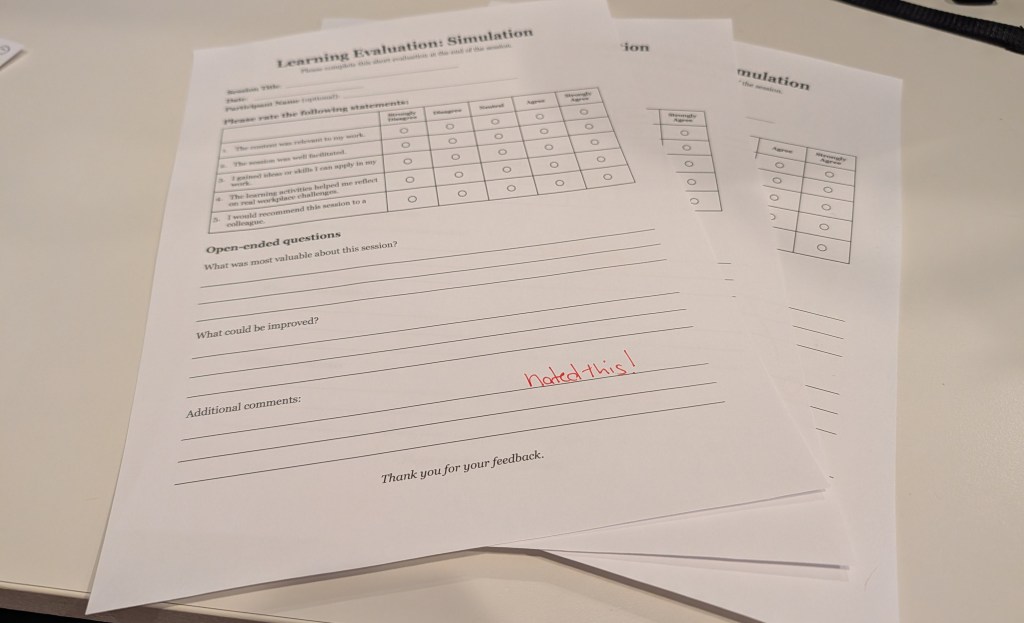
This pilot was something new for the organization, so I tried to brace myself for the handwritten evaluations we collected at the end of the session. Thankfully, it was very well received, with many rave written reviews and a few small constructive suggestions for the next time we ran the training. What a relief.
The following day, however, I got a phone call from a participant who hadn’t filled out the evaluation.
My heart dropped immediately, as she began the call with, “Rob, I wanted to call you personally to let you know how much I hated your course yesterday.” She continued to tell me that the entire experience was uncomfortable, and she couldn’t wait for it to end. She left the training and went straight home, where she was relieved to find her husband to vent to. She told him about the training, and how difficult it was from start to finish. She explained the four stages, the three overarching principles we’d intended to land, and why it was difficult to achieve them. She described exactly what made them difficult, how people actively worked against her on decision making, strategy, and Agile project management.
“I talked to my husband almost nonstop for two hours,” she told me. “And then he said to me, ‘sounds like you got a lot out of this training.’”
I hadn’t seen that coming, and it lifted my spirits – enough to insulate me when she declared that, while she conceded her spouse’s point, she still hated the experience.
Both a win and a caution
This is one of my favorite learning stories to tell. It’s an extreme example of when training led to deep reflection and engagement – even when the learner didn’t enjoy the experience.
Two caveats: I wouldn’t ever set out to build training for antipathy. (You don’t get many plaudits or promotions working in learning and building courses people hate.) And I never intentionally want to put someone through an experience that they consider suffering.
But this simulation worked because we stopped at intervals and very actively drew participants back to the real-work application. They had a sharp emotional response to the make-believe activity, and before they would dismiss it, we showed how it related to their daily leadership challenges, and how to resolve it. Building to moments of tension and then debriefing made the lessons so much more memorable.
It’s this type of deep learning activity is something I worry we’re discounting as we shift attention to AI-assisted and AI-infused learning experiences. While there’s tremendous promise in the customization and personalization of agentified learning, I don’t believe the same emotional cues can be triggered sitting at a keyboard conversing with AI. I definitely can’t imagine getting calls from people eager to tell me how much they learned, despite their hatred of the experience.

