
Field Notes
Observations, stories, and occasional arguments about work, technology, organizations, and the things we tend to miss.
-
Friction and the woman who hated my training
A few years ago, my boss and I designed a day-long leadership simulation. The pilot was designed for 26 participants: each participant followed a detailed role description aligned to a company purpose, and each stage was designed with both a specific challenge to address and an emotional arc. We baked in conflict, whipsaw environmental changes, and inconveniently timed market fluctuations. We segregated people who played the role of customers. We provided a single channel to communicate with the customers: a set of four burner phones. And yes, they ran out of charge and had problems with reception, even though the participants were actually only a few rooms away.
There was a real emotional cost to participating in the training. People got frustrated with themselves, each other, and us. They tried to break the rules. And they really cared about the running score, an estimated change in P&L for their simulated company, and – in relation – their pretend leadership roles.
At the end of each phase, we had a spirited facilitated discussion. I regularly remarked how quickly bad organizational habits manifest themselves in this (and any) simulation. In this case, senior leaders chose to roll up their sleeves and jump into the action instead of creating and communicating vision. Decision making was a mess of ambiguity and too many cooks in the kitchen. Projects were managed haphazardly, and customer input was treated like an annoyance.
“I wanted to let you know how much I hated your course.”
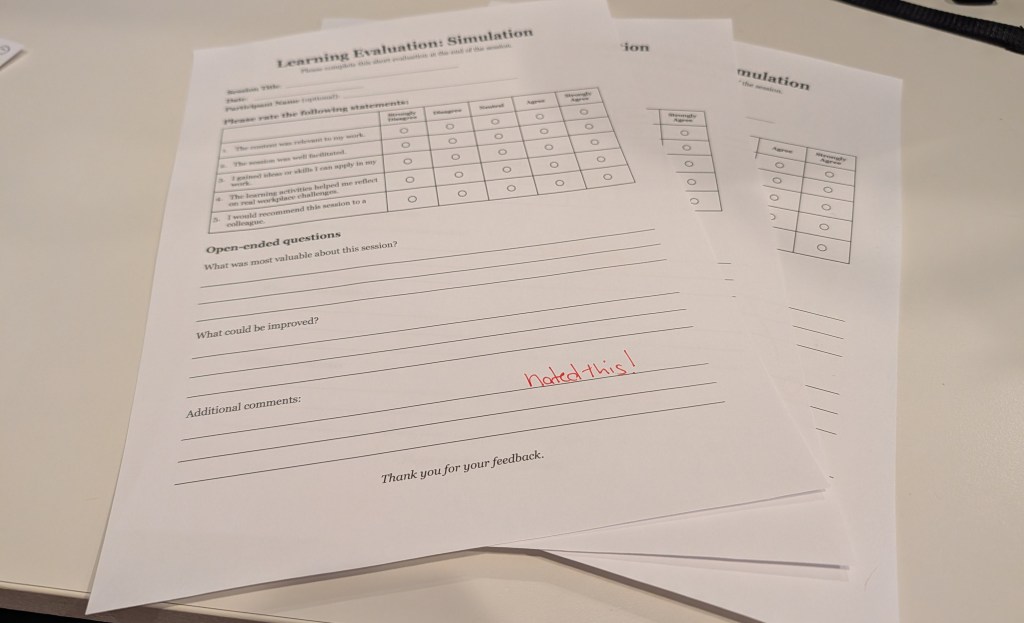
This pilot was something new for the organization, so I tried to brace myself for the handwritten evaluations we collected at the end of the session. Thankfully, it was very well received, with many rave written reviews and a few small constructive suggestions for the next time we ran the training. What a relief.
The following day, however, I got a phone call from a participant who hadn’t filled out the evaluation.
My heart dropped immediately, as she began the call with, “Rob, I wanted to call you personally to let you know how much I hated your course yesterday.” She continued to tell me that the entire experience was uncomfortable, and she couldn’t wait for it to end. She left the training and went straight home, where she was relieved to find her husband to vent to. She told him about the training, and how difficult it was from start to finish. She explained the four stages, the three overarching principles we’d intended to land, and why it was difficult to achieve them. She described exactly what made them difficult, how people actively worked against her on decision making, strategy, and Agile project management.
“I talked to my husband almost nonstop for two hours,” she told me. “And then he said to me, ‘sounds like you got a lot out of this training.’”
I hadn’t seen that coming, and it lifted my spirits – enough to insulate me when she declared that, while she conceded her spouse’s point, she still hated the experience.
Both a win and a caution
This is one of my favorite learning stories to tell. It’s an extreme example of when training led to deep reflection and engagement – even when the learner didn’t enjoy the experience.
Two caveats: I wouldn’t ever set out to build training for antipathy. (You don’t get many plaudits or promotions working in learning and building courses people hate.) And I never intentionally want to put someone through an experience that they consider suffering.
But this simulation worked because we stopped at intervals and very actively drew participants back to the real-work application. They had a sharp emotional response to the make-believe activity, and before they would dismiss it, we showed how it related to their daily leadership challenges, and how to resolve it. Building to moments of tension and then debriefing made the lessons so much more memorable.
It’s this type of deep learning activity is something I worry we’re discounting as we shift attention to AI-assisted and AI-infused learning experiences. While there’s tremendous promise in the customization and personalization of agentified learning, I don’t believe the same emotional cues can be triggered sitting at a keyboard conversing with AI. I definitely can’t imagine getting calls from people eager to tell me how much they learned, despite their hatred of the experience.
-
Familiar frustration with AI enablement
Last month, I spent a lot of time with HR and L&D professionals navigating enterprise AI transformation initiatives. I started October by convening a group of learning leaders across industries to talk about their major challenges.
Our opening round robin focused heavily on AI enablement efforts, and some common themes emerged: there’s a frenzy of activity, interest, and investment without a lot of visible ROI. Business objectives around AI aren’t always clearly articulated, making program design difficult. And technology adoption – even as a proxy – seems a poor metric of success.
It’s a difficult time to be a leader of people teams. The leaders I’ve talked with bring wisdom, experience, and a desire to help both the business and its employees succeed. Yet too often, they’re being asked to chase vague adoption or saturation metrics without a clear vision for how humans should and will work in an AI-transformed workplace.
At the very least, it would be reassuring for them to know they are helping to land changes that improve the organization, its people, or the quality of its work.
All of this has me thinking about my first lesson in technology transformation.
The processor fairy
I was fortunate to land a work-study job with Computer Operations for my last three years of undergrad. Most days, this job involved loading up a panel van with monitors, mice, and CPUs, and rumbling through campus, responding to washed-out work orders printed off a dot-matrix printer in our basement office.
Very little of my job was customer-facing. I had a set of master keys to the campus, and I mostly slipped into unoccupied administrator and professor offices, tweezing out disk covers caught in drives, or swapping out broken monitors and keyboards for clean and new ones. Occasionally we’d get a more rewarding challenge to solve, like fixing a fuzzy monitor by straightening out the pins on a VGA cable or moving a desk fan 6 inches farther from the display.
Once in a while, we’d have a campus-wide hardware or software upgrade, and my exposure to users would increase. One of these initiatives involved unpacking and configuring hundreds of new PCs, then going office-to-office, confiscating old machines and replacing them with brand new ones, like the processor fairy.
There was something deeply satisfying about replacing a hulking AT/PC with a “modern” PS/2. The old machines were heavy and always covered in dust inside and out. The new machines weighed less than half as much, replacing the dark grey boxes with cream-colored ones. The new ones also took up less desk real estate, providing ample room for the mouse and accompanying mousepad. While the floppy disk drives shrank from 5¼ to 3½ inches, the hard disk exploded from 20 to an extravagant 85 megabytes. I always felt heroic wheeling off the old PCs and leaving behind the new.
Who wouldn’t want WordPerfect?
As part of one major replacement, users inherited a whole new suite of software. Instead of booting up to an orange-on-black DOS prompt, they got a Windows desktop and cursor. They also got WordPerfect, the powerful word processor we’d preloaded on the new machines. This was an exciting change, and I enjoyed bestowing it upon everyone.
But there was a holdout. The Philosophy Department secretaries turned us away multiple times when we showed up with their new computers. They didn’t want a new one, and they definitely didn’t want the new software. I registered their resistance with incredulity. Why would anyone want to work from a C:\ prompt on that old steel hulk, when they could cruise around with the mouse on WordPerfect?
When we finally got approval to make the switch, the head department secretary lamented losing access to XyWrite. XyWrite was an old-school, DOS-based word processor. Users often had a plastic keyboard overlay with higher-level F-key functions spelled out.
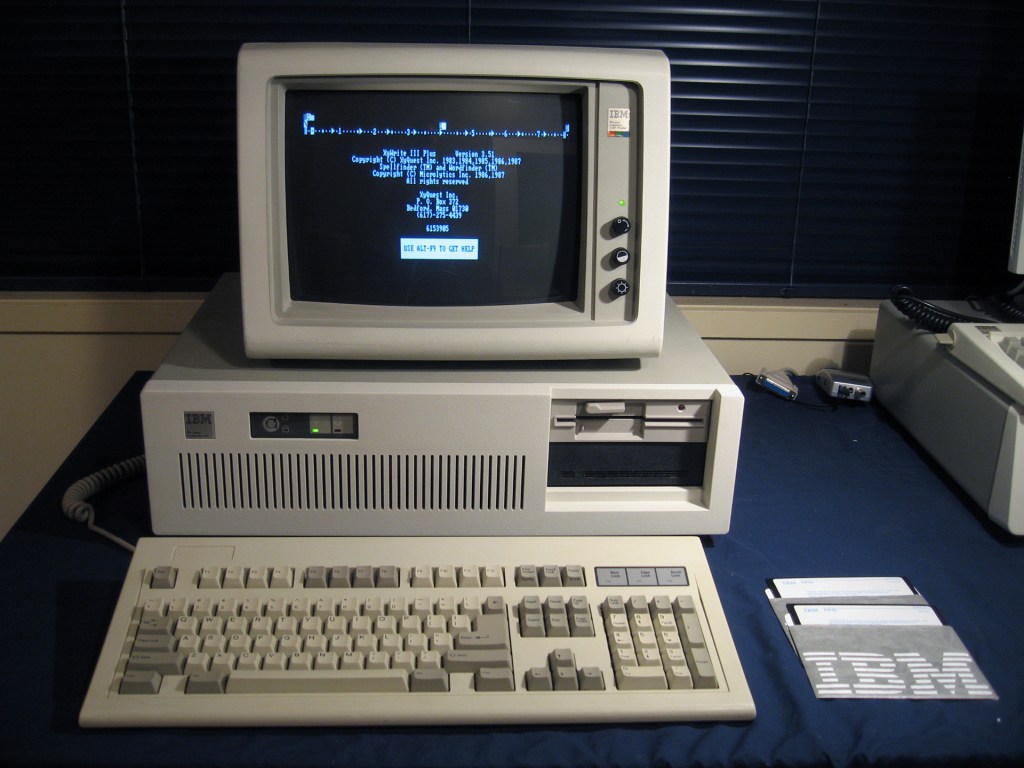
IBM AT computer running XyWrite, photographed by Terry Stewart. Used with permission. Tezza’s Classic Computers It wasn’t until years later that I realized I didn’t have any clue what the department secretaries did, and I never asked. I was a TA for Philosophy, so I saw my favorite department secretary nearly every day. She was always busily typing, hands flying over the keys, never breaking contact to grasp a mouse.
They didn’t see a problem that needed WordPerfect to solve. They were happy with XyWrite and were never asked about transitioning to new software. A student came in with nothing but a work order and a computer, and he disrupted their environment, materially changed their work, and left them accountable to deliver against tight deadlines with demanding stakeholders.
Despite my unshakable power of self-recrimination, I’m not suggesting that the student worker should have known better. I was wowed by the beauty and majesty of the new computers, and I didn’t know enough to ask how they’d be used. We student workers weren’t equipped with any communication – or communication skills – to help with the transition.
Decades later, the work orders haven’t changed much
The Philosophy Department secretaries are on my mind when I talk to people about AI today. Too many initiatives I’ve seen personally and talked about with the folks in my network play out similarly to the WordPerfect/XyWrite story. It’s a company-wide initiative with little or no vision or strategy. Communication is nonexistent, sparse, or poor. Employees are told what’s changing without anyone trying to understand how they work. There may be a bigger business objective behind the technology transformation. But it isn’t shared.
There’s something deeply sad in the realization that today’s people teams, while receiving PowerPoints, emails, and Slack messages that seem so much fancier, are getting work orders eerily similar to the grey, pointillist notes that once guided my workday.
-
In pursuit of learning engagement

As I talk with learning executives in my network, there’s a phenomenon that’s occurring across workplaces: a complete, utter lack of interest in corporate learning. It shows up in one or all of these forms: declining enrollment in virtual or in-person learning programs, cancellations and no shows, and listless or unenthusiastic attendance. In person, that looks like people multitasking on their laptops and phones. Virtually, it means most or all attendees are off camera and muted from the start to the end of the learning session.
It’s tempting to blame this disengagement on AI. The thinking goes something like this: employees don’t know what skills are worth investing in, as AI eats away their roles. Or folks are too demoralized by the looming threat to job security that AI poses. Or people are using AI instead of developing the skills they once needed to do unfamiliar scopes of work.
I’m sure AI has contributed to people spurning internal development opportunities. But I saw learning engagement collapsing even before Generative AI was creeping into our workplaces in 2023. I personally witnessed it a few decades ago, and there were factors present then that persist today.
Mapping my own (dis)engagement journey
Fresh out of grad school, I took a government auditing job in Boston. I was what could be charitably called a HUGE NERD, and – even though I was coming out of 18 straight years of formal education – I was still hungry for more learning opportunities.
Imagine my surprise and delight when I found out that my new organization required everyone to receive at least 40 hours of continuing education every year. I couldn’t wait to get started, and I was eager to take a look at the menu of corporate learning options.
For me, that menu took a physical form – an overstuffed folder with a paperclipped “routing slip” that would be plopped into the inbox that sat on the corner of my desk. That folder had flyers from training companies like Fred Pryor, FranklinCovey, and Lorman. It had brochures on professional organizations like the American Society for Public Administration (ASPA) and the International City/County Management Association (ICMA). And there were order forms for books, videos, CDs, and other educational materials. It was a real, enticing smorgasbord of content.
I can barely describe the professional ecstasy with which I pored over these materials when they initially arrived. I picked all sorts of courses on project management, financial analysis, writing strong findings and reports, understanding public-private partnerships, managing procurement systems, constructing megaprojects, building schools, etc. (Recall that I was and am a huge nerd. Huge.)
I called in or mailed (mailed! We had a franking machine in the copy room…) registration forms. Whether online registration for conferences was available at this time is moot; where I worked, only 2 heavily monitored computers were connected to the Internet. Regardless, the lag between registration and attendance only added to my anticipation.
I can still feel the moment of shock and disappointment when I started to realize how rotten the food at the smorgasbord was. I was nestled into a metal chair balancing a notebook and croissant on my lap, waiting for my first chosen lesson to arrive. And that lesson was at least five minutes late.
What happened?
As I juggled my writing materials and breakfast, I remember watching an unprepared facilitator stumble in and bumble through a few prepared remarks, gleefully announce that he wouldn’t be following the curriculum, and then transition awkwardly to a sales pitch for his other classes and his books (stacked optimistically on a back table). What the hell is this? The “project management” class I signed up for quickly devolved into a training about personal assertiveness and ways to get free airline upgrades. (And many more schemes were available in his $29.99 book!)
I looked around the room at the other attendees. I should note at this point that I was frequently an outlier in these rooms, as I was in the office I joined. At 22, I was exactly half the age of the next youngest team member. The training rooms were similar – folks in the middle of their careers, well-accustomed to these training seminars, and with expectations already calibrated several notches below my own. I looked around for fellow attendees to validate my incredulity, but mostly I found people seemingly resigned to suffer through the experience, get their CEU certificates, and trudge back to the office.
My surprise ossified into resentment and regret quickly, but I vowed that one bad experience wasn’t enough for me to write off the folder sailing from inbox to inbox back at the office. I’d probably just chosen the wrong vendor – or I got an unlucky draw with the hired-gun facilitator who hijacked the session.
Soon, there were so many more bad experiences
It didn’t take long to discover that that first experience wasn’t an aberration; it was a common state of professional education and an accepted standard for this type of experience. In exchange for the $150-$299/hour that it cost to attend these sessions, participants got documented proof of CEU completion. There was no guarantee or expectation of much beyond that slip of paper.
It took a good half dozen subpar classes before the excitement faded and I checked my name off the routing slips without looking through the brochures. Some time after that, I stopped looking in the folder altogether. Repeated disappointments in what I’d experienced led me to write off corporate learning for the next – gulp – decade.
I’d be willing to bet there wasn’t a more eager, engaged learner than me who ever touched that training folder. The first time I put an “x” next to my name on that routing slip, I was buzzing with excitement for the 3-5 learning opportunities I’d identified. And yet, I went from peak interest to complete disengagement within months. What went wrong?
How the folder – and its successors – let me down
It’s been many years since I’ve seen a routing slip or even a single hardcopy training brochure. As a consultant, employee, manager, and executive, I’ve been through dozens of additional workplaces since that first experience. The folder and slip morphed into emails and intranets, MOOCs, databases and LMSs, and now AI and agentic experiences. Consistently, I’ve found learning experiences that don’t just lose my interest. They shake my faith that a learning function will ever be able to supply me with the learning I want. Whether it was the course on writing white papers that became a viewing party for the instructor’s favorite SNL clips or the live webinar that used prerecorded clips that were played during Q&A, I’ve seen dubious value, listless and/or unprepared facilitation, and learners checking out. Regardless of the trendy technology applied or the lessons easily available to glean from learners, the quality of the learning I experience is not any better than when I started. Often, it’s markedly worse. And the sustained evidence made me feel as though the quality learning experiences I wanted were never a priority for the organization.
Recovering the lost learner – it’s easier to change than it seems
I started this note by observing that learning disengagement has been going on longer than the last 3+ years of AI. Naturally, the answers people are coming to me with are very AI-heavy. More agents, more personalization, more learning data ingestion, more recording of learning signals. I’m interested in where some of this can lead. But I’m not sanguine about it as the ultimate solution.
Spending the last decade within learning organizations has given me deeper insight than I had from the outside. And it has reinforced for me that what learners want falls very low down the list of priorities, if it’s even present at all. There’s so much emphasis on being a partner to the business, achieving business impact, and spending time on overall alignment. It’s often hard to fit in the learner’s perspective. Then again, if you never gather that perspective, you won’t be able to integrate it.
Here’s what I recommend – before launching a new engagement strategy, redesigning a curriculum, or (heaven forfend) signing a contract with a vendor for a new AI-infused tool: spend time with your learners. Interviews and focus groups are fine. But so are more casual conversations. Pull up a chair. Ask them what their workday looks like. Find out what they like and don’t like. Ask them what their favorite and least favorite learning experiences were. What was their favorite class/professor – and why? Who’s their favorite YouTuber/TikToker/Influencer and what makes them memorable? (More on that in a coming note.)
Be prepared to be surprised. The conversations will bring up areas of disillusionment you didn’t know existed. And you’ll discover things people enjoy that will give you a fresh perspective on how to think about learning in the future. It feels so much more substantial to redesign the approach to communicating with learners, to hold strategy sessions or build personas. Or to buy that fancy new AI solution. But I’d bet that most learning organizations would make more progress on regaining their disengaged learners just by making more human-to-human connections.

